
The Free Table
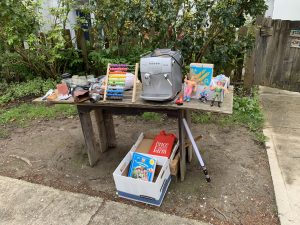
One of Strathcona’s most endearing and enduring institutions is the Free Table, located midway down the 700 block of Union St. It was started over a decade ago by Hugh Tayler, who lives in the co-op. This is its story, told mostly in his words.
Somewhere between 2007 and 2011, Hugh was working on a reno job at Vancouver's most prestigious private school. At the end of the school year, they threw unwanted stuff away. Hugh scored a folding table, which he decided to use for a project that turned out to be part recycling station, part social experiment, part cultural commentary. He set up the table along the sidewalk, laid out some used household items, hung a handwritten sign: “Free Table,” and waited to see what would happen.
“Keeping stuff out of the landfill was the original goal, and many people see the table this way. But years ago, a visitor from Austria identified a broader purpose for the table: der Postwachstumoekonomie, the post-growth economy. He is right. When chatting with people, I often say that the table is just there to remind everyone that we will inevitably transition - "by design or by disaster" - to a closed-loop economy.”
The current table is 6 feet long by 2 feet wide and made from recycled pallets and damaged plywood. The top is one continuous piece so that a few items can be placed under it on rainy days. This is the fifth table. The previous four, which were nicer, were stolen, prompting Hugh to revise the sign: "Things on the table are free. The table is not free."
From the start, it was intended as a project that would be primarily shaped by its users, both those who gave and those who took. “I'm not in charge of the Free Table. No one person is. It's a neighbourhood thing. But my wife June and I sleep right there, thirty feet away from the table, so we tidy up and bring things in at night."
“Our neighbours in the co-op have supported the table, sometimes reluctantly, but with more patience than I would have expected. Many people talk about social progress and community, but my neighbours live up to the ideal. Other neighbours could have complained because it often gets excessive, sometimes in the summer of 2024 spreading to three times the size of the table, but they have been surprisingly patient.”
It's not total freewheeling anarchy. Over the years, Hugh has made a few adjustments. Initially, the Free Table was open for business 24/7. But a few years ago, Joan and Hugh began taking it in at night. “We got tired of drunks dropping stuff on weekend nights and binners showing up at two in the morning to sort stuff and rearrange their bags of cans. Now we haul stuff in at night and tell people, "Don't bring a ton of stuff late in the day that we have to pack up and haul in.”
Some assume that whatever gets put on the table is taken. “Just not true. The inevitable leftovers go in the co-op's recycling and garbage bins. (About 5% to 10%. Some days almost nothing, some days up to 20%.)”
A decade of experience in free trade has taught him what moves and what doesn’t.
For safety and health reasons, he’s had to ban some items: industrial and construction chemicals, mattresses and box springs, upholstered furniture that might have bedbugs, and kitchen knives or weapons.
Other items are discouraged. Dead barbecues. Incomplete or damaged Ikea furniture, the stuff that turns to mush in the rain. Car seats, kid's furniture, and large play items are different problems. “You don't know their history; they have fabrics that are difficult to remove and clean, and thrift stores don't want them. Large play sets like Hot Wheels tracks may have no safety issues, but they are just too big for many families; some contain electronics that need to be removed for recycling, and in some cases, the whole set is useless if pieces go missing. Large kid stuff should go directly from parent to parent, and so should maternity items like electric breast pump kits and baby feeding systems.”
Then there are items that Hugh dubs “emotionally problematic.” “These are personal family items like photo albums, cameras, phones, or computers with personal pictures or data. I have a protocol that I follow to preserve confidentiality, and a couple of times, we have been able to get stuff back to someone who appreciates it. Other times, I run a scrubbing program or do a system reset.”
Some items are slow movers. “Canadian sociology, books in Dutch or Russian, religious stuff, obsolete ski boots, dirty baby gear, impractical baby fashion items, and fast fashion in cheap fabrics. Everyone has a different definition of value. There is no escaping the fact that some people are going to generously bring ripped but repairable clothing, decaying fake Gucci handbags, their collection of extra take-out cutlery, almost-fixable Disney electronics, and sealed jars of good food that are over their expiry date. And, surprising to some, many of these marginal things eventually find a home.”
The items that tend to fly off the table are “kitchenware, towels, any practical clothes in decent shape for any age group over eighteen months, fixable bicycles, electronics and appliances that still work and have a purpose. Classic washable toys with sustained play value are steady movers and we often have a little box for random mismatched toys located down where toddlers can forage through them.”
Then there is the underwear paradox. “Men's underwear is not in big demand. Women's underwear always disappears quickly, although we recently had an oversupply of padded bras.”
The oddest item? “Our neighbour Theo found two live rats in a lunch kit and adopted them as pets. About a week later, a young woman leading a difficult life showed up looking for her rats. Joan told her that the rats now had a good home. Another memorable one was half a birthday cake, still fresh and presumably appealing to whoever took it.”
“I actually do resell some stuff—not much, but some, especially heirloom items that should go to someone with the right technical skills or collector knowledge. I hate seeing someone's much-loved old camera gear mistreated on the table. If we get classic stereo gear, I will divert it to a neighbour who will check it, recondition it, and find people who appreciate it. Cash from sales bought $100 worth of sushi for our co-op potluck this summer.”
What has the Free Table taught Hugh about human nature? "About 10% of people are really honest, more honest than I am, but about 80% are pretty good. Another 15% have trouble behaving themselves unless someone is watching them, and about half of one percent will just look you straight in the eye and lie and steal."